
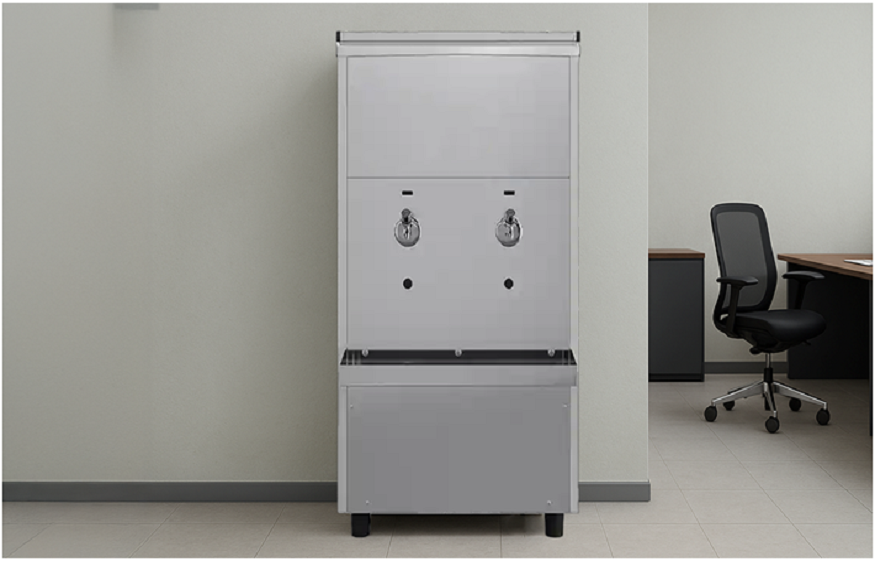
Water Cooler Size vs Footfall, Getting the Match RightWater Cooler Size vs Footfall, Getting the Match Right
Safe, clean, and refreshing drinking water is a basic necessity for corporate offices, hospitals, factories, commercial complexes and educational institutions. But home water purifiers or 20-litre bottled water jars simply cannot meet the peak requirements of high-traffic environments. Therefore, it is important for the facility managers to opt for commercial water coolers with built-in purification systems. These are designed for high output, long-lasting durability, continuous performance, and long-term energy efficiency.
Choosing the right water cooler size based on the daily footfall in your facility is important to avoid long queues during break hours, ensure uninterrupted hydration, and prevent premature mechanical wear.
The Hydration Challenge in High-Footfall EnvironmentsThe Hydration Challenge in High-Footfall Environments
To manage the high-volume water demand in commercial spaces like corporate canteens, hospitals, and factories, facility managers often replace ordinary systems with commercial water cooling and purification systems. This helps avoid shortages, downtime, and high maintenance costs.
Read More : True HEPA vs HEPA-Type: What’s the Real Difference?
- Continuous High-Volume Supply: Integrated water storage tanks ensure that purified and chilled water remains available even during peak hours and when there is a power cut.
- Hygienic and Contamination-Free Dispensing: The dispensing process is hygienic and free from contamination since purified water is kept in airtight food-grade storage containers which guard it against dust, heat, airborne bacteria and the risks associated with having to manually swap bottles.
- Cost and Logistics Efficiency: When you have direct-line systems that link directly to the raw water source, there’s no need to buy the jars, manage their deliveries, or store them.
Drinking water demand differs widely during the day in crowded commercial places. Water usage peaks at shift changes, lunch hours and scheduled breaks. So to cut down on hassle and keep water output steady, drinking water cooler machines become a necessity. This leads right into our next step on how to choose the right cooler size for your needs.
Matching Water Cooler Size to Facility Requirements
Internal storage capacity (litres) versus continuous purification throughput (litres per hour – LPH) counteracts supply bottlenecks for smooth operation during peak break hours:
- Small Offices & Executive Suites (15.5L – 40L Storage / 25–50 LPH Output): Suitable for workforces consisting of between 15 and 40 people and offers a compact design together with continuous purification.
- Medium Corporate Floors & Retail Outlets (40L – 80L Storage / 50–80 LPH Output): Have quicker chilling recovery rates and provide larger immediate storage reserves for 40 to 80 people.
- Factories, Hospitals & Educational Campuses (80L – 120L Storage / 80–120 LPH Output): The stand-alone heavy-duty systems designed for shifts with a high number of people and for use in public areas (serving 100 or more users) have a storage capacity of 80 to 120 litres and an output rate of 80 to 120 litres per hour, ensuring that there is no downtime when the shifts change.
Other Important Features to Look for in Commercial Water Coolers
1.Durable Stainless Steel Construction1. Durable Stainless Steel Construction
Equipment put into commercial premises that have a high volume of foot traffic must be capable of handling constant daily use, physical impact, and environmental deterioration. Systems that have inner storage tanks and outer casings made of surgical-grade SS 304 stainless steel provide good corrosion resistance, structural durability, and easy sanitising, without the possibility of bacterial biofilm forming inside the storage tanks.
2. Multi-Barrier Purification Integration
Water of an unpredictable quality—whether it comes from the municipal water supply or from high-TDS groundwater (500 to 2000 ppm)—has to be treated using commercial equipment. Heavy-duty systems incorporate complete multi-stage filtration technologies.
- Pre-Filtration (Sediment & Chemi-Block): In the pre-filtration stage (using the Sediment & Chemi-Block), leftover chlorine, unpleasant odours, and volatile organic compounds are absorbed, along with physical particles such as mud, rust, and suspended dust.
- Reverse Osmosis (RO) Membrane: The reverse osmosis (RO) membrane eliminates the excess total dissolved solids (TDS), as well as the dissolved chemical contaminants and hazardous heavy metals such as lead and arsenic.
- UV E-Boiling Chamber: The UV E-Boiling Chamber uses strong UV light to eliminate harmful germs and viruses and thus achieves a level of water safety equivalent to that obtained by boiling water for over 20 minutes.
3. High-Capacity Chilling and Multi-Temperature Dispensing
The water that is stored is rapidly cooled using powerful refrigeration compressors and continuous cooling coils. More sophisticated features are also provided in the commercial models, since these offer a range of temperature settings (Ambient, Cold and Hot), enabling users to enjoy hot water for making tea or coffee as well as having water at room temperature and chilled water without having to empty the main cooling tank.
Key Maintenance Considerations
An organised maintenance programme increases the life of equipment, optimises power consumption and keeps the water pure:
- depending on the TDS level of the feed water and the total amount produced; because of the high capacity of the filter cartridges, the maintenance intervals can be extended to a maximum of 2 years or 12,000 or more litres, thus lowering the total operating costs.
- Systemic Tank Sanitisation: The stainless steel tanks and the distribution lines are regularly cleaned and flushed in order to prevent the build-up of biofilm and to ensure that the taste remains fresh.
Read More : Top Factors to Consider Before Buying a Ceiling Fan
- Energy Management: Automated thermostats make sure that the compressors switch off when the desired chilling temperatures have been reached, thus preventing unnecessary energy use.
Conclusion
It is important to select the correct size for a commercial water cooler based on the number of people who visit your facility each day if you are to maintain proper hygiene standards, prevent operational bottlenecks and cut down on long-term operating costs. You should choose a robust water cooler made from stainless steel which has multi-stage purification so that safe, chilled drinking water can be provided every day for your employees, visitors and customers.